Create a distributed legal messaging namespace where cryptographically
verifiable evidence packages can travel over any transport mechanism,
while trust remains anchored in DNS and the domain owner.
Our Vision
KUTCHY promotes a DNS-native legal messaging infrastructure where every
domain owner can publish and operate its own trusted communication
capabilities.
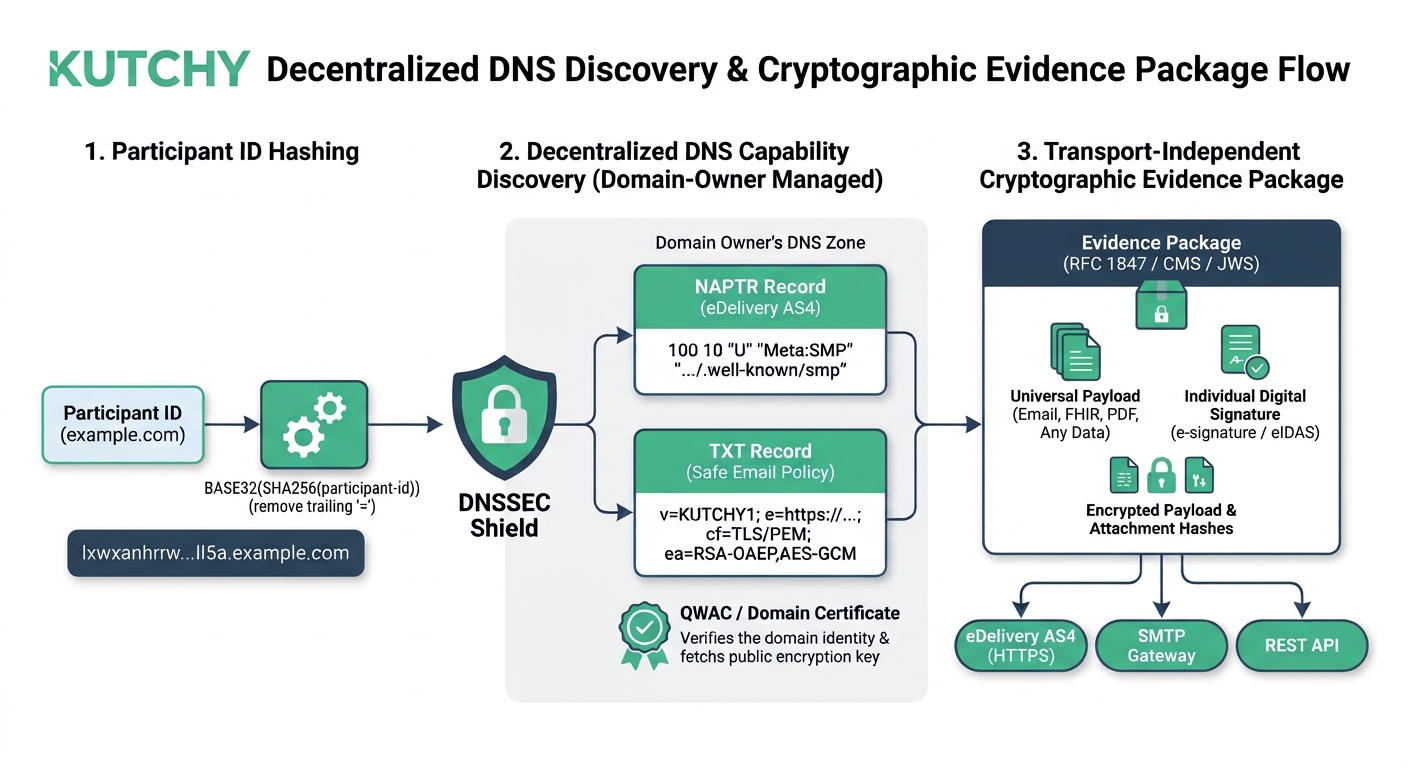
While Safe Email uses RFC 1847 (multipart/signed and multipart/encrypted) to wrap standard message/rfc822 emails, RFC 1847 is completely content-agnostic. KUTCHY applies the exact same decentralized DNS discovery
and cryptographic evidence packaging to any structured or binary data file—including HL7 FHIR health records, DICOM medical imaging, PDFs, JSON payloads, and XML documents—using established open standards
(RFC 1847, RFC 5652 CMS / ETSI CAdES, and RFC 7515 JWS / ETSI JAdES).
Just as a domain owner publishes MX records for email, it should also be
possible to publish:
eDelivery AS4 endpoints
Gateway email addresses
REST API endpoints
Supported digital identity providers
Encryption capabilities
Evidence package policies
No central registry should be mandatory.
The owner of the domain should remain the owner of its legal messaging
namespace.
DNS discovery follows EU-identified practice
KUTCHY publishes a domain's legal messaging capabilities in DNS, where any
application can look them up without a central registry. The underlying
Domain Name System (DNS) is identified by the European Commission as
eligible for referencing in public procurement
(Implementing Decision (EU) 2017/168),
and DNSSEC, which protects the published records against tampering, is
identified in
Implementing Decision 2014/188/EU.
Publishing policy and service information in DNS is established practice
among the identified specifications. DKIM (2014/188/EU), SPF and DANE-SMTP
(Implementing Decision (EU) 2017/2288)
all let a domain declare in DNS how its messages are to be authenticated
and secured.
KUTCHY's participant lookup uses NAPTR records with hashed participant
identifiers, the same pattern as OASIS BDX Location, the service discovery
specification used with eDelivery AS4. Both are identified in
Implementing Decision (EU) 2016/1765.
By using RFC 1847 (multipart/signed & multipart/encrypted) paired with application/jose+json (or application/json) instead of legacy binary pkcs7-mime / .p7s blobs, your evidence package natively carries modern eIDAS
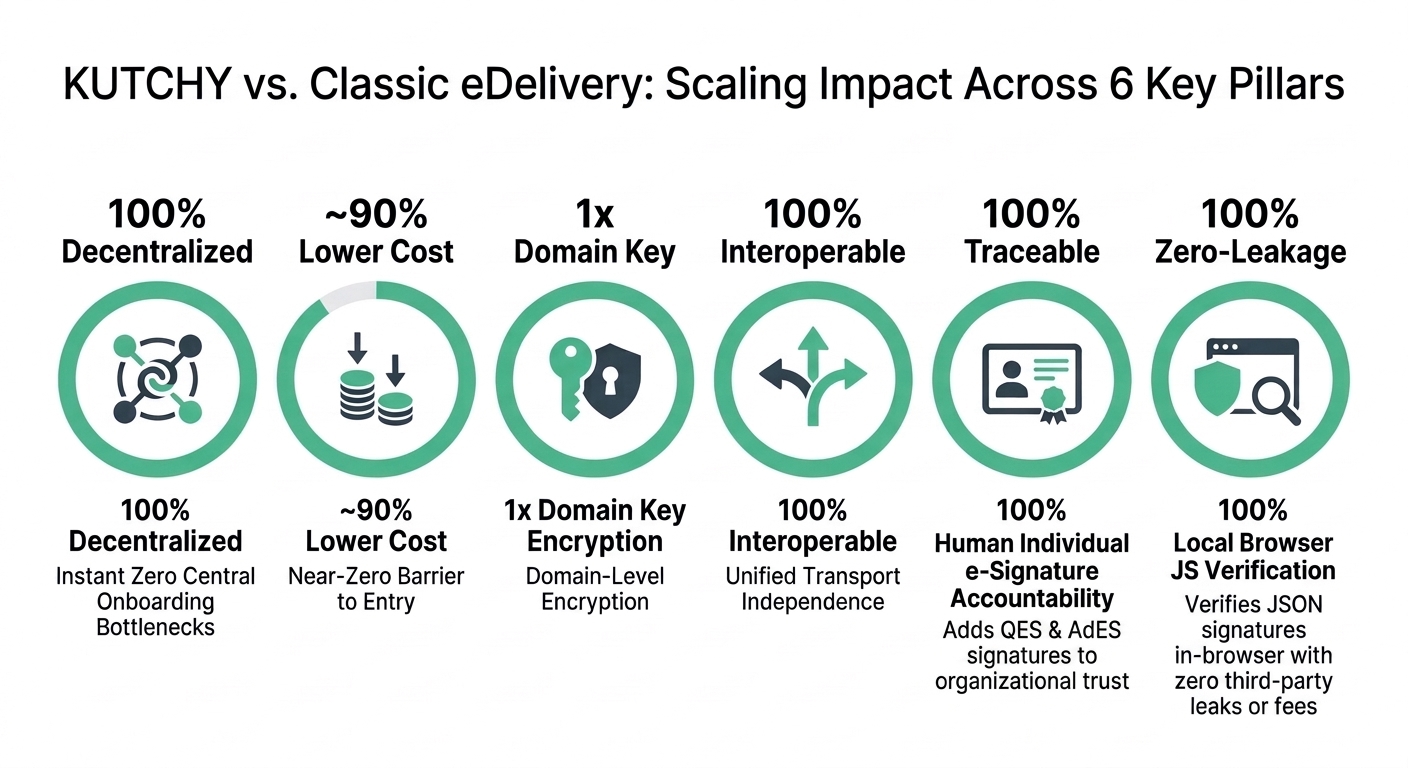
JSON/XML signature tokens—and can be verified 100% locally in the recipient's browser using pure JavaScript with zero external validation calls, zero data leakage, and zero verification fees.
Built on standards identified by the European Commission
KUTCHY builds on MIME, DNS, SMTP, TLS and X.509 (PKIX), all identified by
the European Commission as eligible for referencing in public procurement
(Commission Implementing Decision (EU) 2017/168,
adopted under Article 13 of Regulation (EU) No 1025/2012).
RFC 1847,
the MIME security framework KUTCHY uses for signing and encryption, is
listed in the Commission's
ICT Standards for Procurement
collection on the Interoperable Europe Portal.
The Internet already has a global, distributed namespace.
There is no technical reason why legally reliable digital communications
should depend on a centralized directory.
The Participant Namespace
KUTCHY defines a DNS-native namespace for legal messaging.
Each messaging domain or application defines its own participant identifier format.
A participant identifier is transformed into a deterministic DNS label using a published hashing profile.
For Safe Email, the participant identifier is:
example.com
and the DNS label is calculated with lowercase input, UTF-8, standard Base32 alphabet (RFC 4648), lowercase output, padding removed as: Remove '=' padding (BASE32(SHA256(participant-id)))
This architecture allows multiple legal messaging ecosystems to coexist while sharing the same decentralized DNS discovery framework.
    SHA-256
        ↓
    Base32
        ↓
    Remove '=' padding
        ↓
    DNS subdomain
The resulting label is published under the KUTCHY namespace (DNS TXT):
KUTCHY defines the framework. Safe Email defines one participant profile.
Deploy Your Sovereign Gateway
Generate your compliant metadata and copy the serverless Terraform script to publish your secure gateway directly under your own AWS account infrastructure.
main.tf
To speciry where you publish your encryption certificate, use: type=The URL or DNS location to certificate.
Lists of the "type" parameter values:
TLS: The certificate of the https domain used in the TLS hand shake. Needs to be a certificate with a SAN domain even if it is used for a subdomain as well. Example: https://example.com
PEM: A https URL containing the pem file with the domain in the SAN field. Example: https://example.com/.well-known/kutchy.pem
TXT: Pointing to a TXT dns (Kutchy) record of the domain (strict) or subdomain (relaxed) with the encryption certificate in base64 format in the TXT field. Like the way DKIM works. Example: example.com
DKIM: Using the actual DKIM that is used for signing emails, to encrypt emails to the reciepient. Example: (TXT) example.com Value: (the public key that is base64 encoded)
NAPTR: Using the eDelivery building block specification from EUS's eIDAS regulation. NAPTR is a dns record pointing to a ULR where you retrieve the PEM certificate and retrieve the URL address (API) to send the encrypted email/file to. Example: (NAPTR) mpdgulm4yax5h2xjgexvraliy6entazyhh2bsw53hew7dckjxzla.iso6523-actorid-upis.example.com Value: (the URL value)
Deploy your own Safe Email gateway in under one hour for free.
Use your own domain.
Keep your own keys.
Run in your own cloud account.
Receive encrypted email for free.
Upgrade to digital signatures and eDelivery when needed.
KUTCHY Safe Email conclution
Free to receive.
Free to encrypt.
Free to verify.
Receive encrypted email for free.
Bring your own domain.
Bring your own keys.
Keep your own infrastructure.
Upgrade to digital signatures, eDelivery and DNSSEC when you are ready.
Kutchy simplify safe communication with existing open standards, rules and laws into a neat solution.
To exchange email and data in a secure and compliant way, there are already international technical standards and legal framework since long ago to accomplish that.
Why are you not already using it? It is because a user-friendly interface, affordable and decentralized way for each domain owner to configure it has been missing.
Kutchy brings these existing standards in a neat solution where you with ease can have a safer email and data exchange using your current email and cloud providers.
Example of a received email where you can see missing DKIM and DMARC:
Example of a received, decrypted and verified email:
Example of a sending an encrypted email where the receiver have safe and compliant eDelivery:
Example of sending an email where you can see who the receiver organization is:
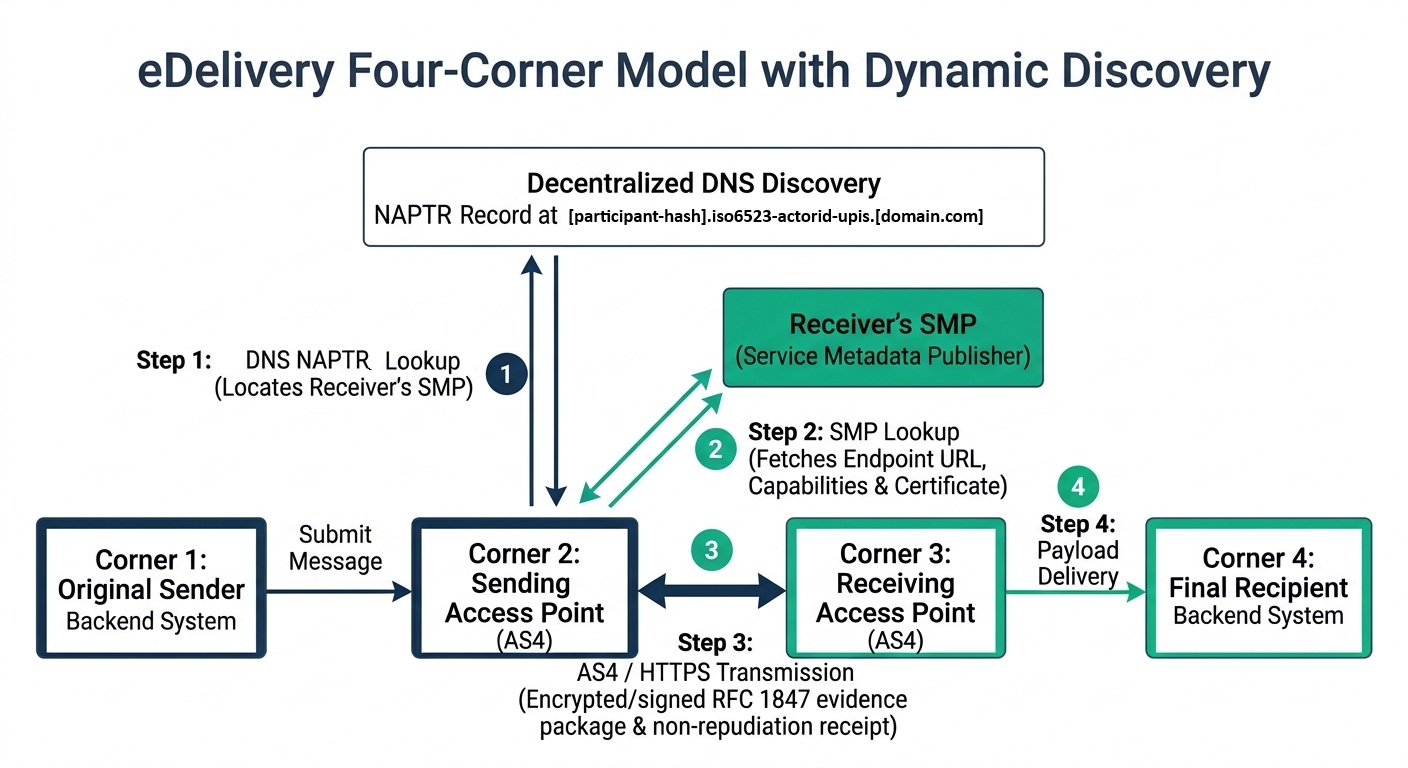
Secure and compliant data exchange: The European Commission ("EC") has understood how important and fundamental it is for the EU's public and private sector to have a trusted, secure and compliant data exchange. For that reason EC created eIDAS (The Regulation on electronic identification and trust services for electronic transactions) regulation, and within eIDAS defined the eDelivery framework. eIDAS is a key enabler for secure cross-border transactions. eDelivery provides technical specifications and standards, installable software and ancillary services to allow projects to create a network (file/message type) of nodes (participants) for secure digital data exchange. However, eDelivery's uses AS4 (https) OASIS ebXML message which is agnostic to what kind of files and data that is exchanged between parties asynchrony. The older version AS2 is used for communication with banks when sending SWIFT or ISO20022 messages to them.
eDelivery in the end claim to solve issues as:
Interoperability
Scalability and performance
Security and accountability
Vendor and platform agnostic
Finding connected eDelivery/AS4 parties in a decentralized internet
Flexible and configurable
Still, the main difficulties below higlight the centralized networks did not solve data and email exchange on the internet.
Problems setting up secure information exchange
eDelivery's issues
Centralized solutions: EC thought it would be necessary to have a central Service Metadata Locator (SML) to control each network for each kind of message and its participants verified unique ID, API url and compliant with technical requirements. With eDelivery's current central SML, it becomes very detrimental to scale connectivity, heavy administration and pricy for smaller organizations. EC therefor made a consultation to the public of how to improve the eIDAS regulation and recently for eInvoice. EC's CEF eDelivery information of SML and SMP in pdf is found here.
SMP is also more centrally administrated.
Manual connectivity: The SMP and connectivity check and security compliance is monitored and should be reported if unfit. A party can be disconnected if the network revoke the party's certificate.
Lack individual traceability: eDelivery does not address that in many cases that the receiver needs to know the individual who sent a file or data.
Email
Pricy and burdensome administrating of individual certificates per user: The signed and encrypted email standard RFC1847 was thought to have an encryption and decryption key for each user, that turned very administrative to handle and technical to set up. The standard does not require each individual to have it's own encyption certificate, but signature.
Big tech companies never adopted encrypted email standards: Most large email providers and software did not support it out of the box, so usually you will need to chose an email provider and software to use signed and encrypted emails.
Missing legal compliance: More recent privacy, GDPR, LGPD and data protection act regulations sometimes question that the entire email was not encrypted so the exchanging parties and the subject information is visible to external parties.
Insecure SMTP: Emails are transferred over the inherently insecure asynchrony SMTP (Simple Mail Transfer Protocol) with limited DKIM, SPF and DMARC implementation in general for safety. Even as most email servers implement TLS over the SMTP protocol, each server the email passes on the way to the recipient can read and modify the email while in transit.
Solution for eDelivery and Email
Migrating from SMTP to https: Your email provider may have support for both SMTP and https (eDelivery) to receive and send emails.
Automated security implementation: To handle encryption, it is easier and safer to use the publicly known home page domain certificate for every email user in that domain rather then using per user certificates, and to encrypt the entire email rather then part of the email as body and attachments to comply with privacy. Optionally, defined in a TXT record to use it's certificate, or VMC instead for encryption. To decrypt emails, you do not let users access the private key to decrypt, but only let the user to have access to the function (API) to decrypt its own emails. The function lets the organization's system verifying the user and scan the email for malware prior to return the decrypted email to the user.
Decentralized automatic connectivity: Kutchy framwork propose an open and decentralized internet solution for secure and compliant data and email exchange and this white paper contribute to EC consultation for improvements of eDelivery. Kutchy white paper propose that each domain (URL) owner configure their own SML (Service Metadata Locator) and DNS themself and with it, the other participants of the networks can automatically verify its connectivity, ID and security prior to data exchange. It is applicable to both email and API. Just like you configure your DNS for your home page A record and email provider MX record.
The SML and SMP connectivity check and security compliance is verified automatically and visible to the user, like in the Kutchy Add-in prior to sending any email.
Legal compliance: eDelivery is very applicable to emails to substitutes the insecure asynchrony SMTP that has been debated for long time how to merge to safer https.
In any case, a signed and encrypted email using the RFC1847 on the entire email over eDelivery, you can verify organizations prior to sending emails that is signed by the individual and on message level verified organization. To add the signed and encrypted email functionality of today's classic SMTP transfer of emails, Kutchy Add-In provides this functionality out of the box for every user to send it over classic SMTP or/and eDelivery. Using the receiver’s domain's certificate instead of a per user classic public encryption key, administration is diminished, whereas trust, compliance, privacy, security, ID verification, simplicity, affordability and usability is greatly enhanced. Some has suggested that the eDelivery for emails would substitute fax messages.
Affordability: A solution that may use your current homepage domain certificate och other public certificate belonging to your domain, such as the security.txtfile on sites, to receive encrypted emails and configure your DNS is a favorable to include all domain owners in society and not only for the large organizations.
Implementation steps for high trust
Configure TXT record to set Kutchy framework policies for ordinary SMTP email, eDelivery and API.
Set DNSSEC on your domain.
Get a QWAC for your domain, API and eDelivery URLs.
Configure NAPTR for eDelivery networks for secure email.
Trust in QWAC (Qualified Website Authenticated Certificate)
Highest trust as a party/node, you need to obtain a QWAC (Qualified Website Authenticated Certificate) where you usually are required to go to a notary and prove who you are, being a signatory of said organization and prove that you control your domain. The QWAC works both as a server and client certificate and commonly used between banks in API and is part of the eIDAS regulation.
The less trusted domain/server certificates are EV (extended Validation), OV (Organization Validation) or least trusted DV (domain validation) certificates.
VMC - Verified Mark Certificate
This is a certificate that cryptographically proves your intelectual property right from World Intellectual Property Organization’s (WIPO) of trade marks and points our where the logo (or name) and certificate can be obtained and verified in a BIMI record defined in a TXT DNS record like default._bimi.[yourdomain.com].
The BIMI record with link to created logo and certificate will make it possible for the recepient of your emails to see your logo in their inbox of your email, for them to trust your emails.
It is a EV (extended Validation) certificate for your trade mark's logo, not for your homepage https connection. The certificate is usually allowed to be used for s/mime encryption and signature.
According to eDelivery rules, the participant-id for a node in a network shall be hashed by SHA256, then base32 encoded, removed "=" (equal sign) and set as the sub-domain of your domain, as it is allowed to set your own SML network's organization to your own NAPTR DNS. This rule makes everyone able to find out what domains adhere to secure email exchange defined by eIDAS regulation.
An example for email over eDelivery for the domain kutchy.com would have the participant-id: 0203:kutchy.com to be hashed by SHA256 and encoded and removed the equal sign "=" and then add the iso6523-actorid-upis before the domain would result in NAPTR record to become: bi5mzop5ffjfb5eocpt7z53xjce2pn6fbr6d42kfuakpts2tqspa.iso6523-actorid-upis.kutchy.com
An example for signed and encrypted email over SMTP for the domain kutchy.com would have a TXT record for the kutchy.com domain where you can define 1-3 URLs in tags. One tag for encryption, potentially another for ID, and a third URL for the API enpoint receiving email via https/eDelivery instead of SMTP.
Encryption (e=URL) https URL to the public certificate that shall be used to encrypt the data. That api shall return a web reply header "KUTCHY" that states what encryption it wants for the data to be sent. Should be the same domain or sub domain.
Idetity (id=URL) https URL to verify the identity of the domain. Has to point to a domain certificate that has its Common Name (AKA CN) with the domain or includes the domain in one of its SAN (Subject Alternative Name) extension field. SAN, a term often used to refer to a multi-domain SSL certificate.
API location (l=URL) https API URL where to send the data (required for eDelivery email, not for SMTP). Can point to a third party provider's URL, commonly a cloud provider or via CNAME.
Example of a TXT record found at: l6s5ggdn2ac247mocuihs3ef37xvfjadeaoozqqey2w6uptbxjqa.kutchy.com
Kutchy TXT DNS record: The sub record is calculated by sha256 hashing domain and then base32 the string and removing the = signs (example guid for kutchy.com is l6s5ggdn2ac247mocuihs3ef37xvfjadeaoozqqey2w6uptbxjqa). Fill in your own domain here and then click tab to get your own guid.
Version: v=KUTCHY1 indicates the version of the KUTCHY record.
Encryption Certificate Location: e=The URI to the public certificate to use for encrypting file(s), email(s) or data. It may be a sub URL. The web response shall have a KUTCHY header with values. Or DNS record shall have necessary tags.
Certificate Form: cf=Relats to e. Encryption certificate form specify how the certificates is formed at the pointed out certificate logcation. Possible parameter values are: PEM, TLS, TXT, DKIM, NAPTR. If it is the tls certificate in https communication that is used, or a pem file at a unique URL (https) link or from an WSDL/XML file on a site, like for a SMP URL location according to eIDAS regulations building block eDelivery. Or the DKIM value in a TXT record.
Lists of "cf" parameter values:
PEM: A https URL containing the pem file with the domain in the SAN field.
TLS: The certificate of the https domain used in the TLS hand shake. Needs to be a certificate with a SAN domain even if it is used for a subdomain as well.
TXT: Pointing to a TXT dns (Kutchy) record of the domain (strict) or subdomain (relaxed) with the encryption certificate in base64 format in the TXT field. Like the way DKIM works.
DKIM: Using the actual DKIM that is used for signing emails, to encrypt emails to the reciepient.
NAPTR: Using the eDelivery building block specification from EUS's eIDAS regulation. NAPTR is a dns record pointing to a ULR where you retrieve the PEM certificate and retrieve the URL address (API) to send the encrypted email/file to.
Encryption algorithm: ea=Relats to e. Encryption algorithem that is applied. List of tags: RSA-OAEP, RSA-PSS, RSASSA-PKCS1-v1_5, AES-CTR, AES-CBC, ,AES-GCM, PBKDF2, HKDF, Ed25519, and X25519.
Lists of "ea" common parameter values:
RSA-OAEP: Used for public certificate asymetric encryption/decryption of emails.
AES-GCM: (Advanced Encryption Standard with Galois/Counter Mode) is a widely used authenticated symetric encryption/decryption algorithm that combines data encryption with integrity protection. It provides both confidentiality (ensuring that only authorized parties can read the data) and authenticity (ensuring that the data hasn't been tampered with).
AES-CBC: (Advanced Encryption Standard with Cipher Block Chaining) A widely used symectric encryption/decryption algorithm that combines the AES block cipher with the CBC mode of operation. It encrypts data in fixed-size blocks, with each block's output being dependent on the previous block's ciphertext, enhancing security.
AES-CTR: (Advanced Encryption Standard in Counter mode) is symetric encryption/decryption way to use the AES block cipher as a stream cipher. It transforms a block cipher into a stream cipher by encrypting a counter and XORing the result with the plaintext. This process is efficient and allows for parallel processing, making it suitable for high-performance applications.
Recommended tags
Nonce: n= Is the 'nonce in base64 format and used for encryption/decryption. Prefered to use this tab insteada of putting the nonce before the encrypted data. (Used for AES-GMC)
Tag: t= The authentication tag produced for AES-GCM message during encryption. Only used for GCM and for authentication algorithm.
Initialization Vector: iv= Is the Initialization Vector in base64 format and used for encryption/decryption. Prefered to use this tab insteada of putting the iv before the encrypted data. (Used for AES-CBC)
Hash alrogrithm: ha=Hahs algorithem that is applied. Example value: "RS256". Possible values are:
Algorithm Parameter, Value: Algorithm
HS256: HMAC using SHA-256 hash algorithm
HS384: HMAC using SHA-384 hash algorithm
HS512: HMAC using SHA-512 hash algorithm
RS256: RSA using SHA-256 hash algorithm
RS384: RSA using SHA-384 hash algorithm
RS512: RSA using SHA-512 hash algorithm
ES256: ECDSA using P-256 curve and SHA-256 hash algorithm
ES384: ECDSA using P-384 curve and SHA-384 hash algorithm
ES512: ECDSA using P-521 curve and SHA-512 hash algorithm
Identity: id=https URL to verify the identity of the domain. Has to point to a domain certificate that has its Common Name (AKA CN) with the domain or includes the domain in one of its SAN (Subject Alternative Name) extension field. SAN, a term often used to refer to a multi-domain SSL certificate. Example is a url to a pem of a Verified Mark Certificate, https://amplify.valimail.com/bimi/time-warner/I0vDrJpkRnB-cable_news_network_inc2025.pem
Identity of UBS/PSC: ids=An electronic digital signature encoded in base64 of the ultimate beneficial (UBO(s), PSC(s)) owner of the domain, for whom it must be used for and by. Commonly a JWS.
Identity provider: idp=Relates to ids. The provider or/and issuer of the digital signature to know how to verify the electronic digital signature. Example: frejaeid.com, bankid.com, GOOGLE, MICROSOFT, UBISECURE, QSEAL and APPLE.
DKIM selector: ds=DKIM selector to the subdomain to [selector._domainkey.domain.com] to find and check DKIM and DMARC compliance prior to sending an email. Example: default
Email gateway: egw=Email address that acts as a gateway for all incoming encrypted emails. Example: gtw@kutchy.com
Optional tags
URL to api: l=URI to the API to receive file(s), email(s) and data. Example: https://kutchy.peppol.eu
API type: lt=Type of API to expect, like eDevliery version. Example: edelivery, AS2, AS4, MX
API IP address: lip=The IP addresses from where the api request come from this domain when it wants to send and restrict external party's domain api requests and add security. Example: 192.162.0.1 Or like the DNS MX record sets span of IP addresses and alternative IP.
BIMI selector: bs=BIMI selector subdomain value to [selector]._bimi.domain.com to find and check if BIMI record exist and retreive the owner, logo and certificate info.
ID agreement hash value: idh=The hash value of a digital agreement for an ID provider to verify domain.
CA agreement hash value: cah=The hash value of a digital agreement for a CA (Certificate Authority) to verify domain.
Kutchy header in encrypted email files (.eml, .p7s, .p7m, .asc, and other)
Required file header tags
Kutchy header: Kutchy: Is the header to display that this record and file addhere to Kutchy policy and following tags.
Version: v=KUTCHY1 indicates the version of the KUTCHY record.
Encryption algorithm: ea=Relats to e. Encryption algorithem that is applied. List of tags: RSA-OAEP, RSA-PSS, RSASSA-PKCS1-v1_5, AES-CTR, AES-CBC, ,AES-GCM, PBKDF2, HKDF, Ed25519, and X25519.
Lists of "ea" common parameter values:
RSA-OAEP: Used for public certificate asymetric encryption/decryption of emails.
AES-GCM: (Advanced Encryption Standard with Galois/Counter Mode) is a widely used authenticated symetric encryption/decryption algorithm that combines data encryption with integrity protection. It provides both confidentiality (ensuring that only authorized parties can read the data) and authenticity (ensuring that the data hasn't been tampered with).
AES-CBC: (Advanced Encryption Standard with Cipher Block Chaining) A widely used symectric encryption/decryption algorithm that combines the AES block cipher with the CBC mode of operation. It encrypts data in fixed-size blocks, with each block's output being dependent on the previous block's ciphertext, enhancing security.
AES-CTR: (Advanced Encryption Standard in Counter mode) is symetric encryption/decryption way to use the AES block cipher as a stream cipher. It transforms a block cipher into a stream cipher by encrypting a counter and XORing the result with the plaintext. This process is efficient and allows for parallel processing, making it suitable for high-performance applications.
Recommended file header tags
Hash algorithem: ha=Hash algorithem that is applied. Example value: "RS256". Possible values are:
Alg Parameter Value: Algorithm
HS256: HMAC using SHA-256 hash algorithm
HS384: HMAC using SHA-384 hash algorithm
HS512: HMAC using SHA-512 hash algorithm
RS256: RSA using SHA-256 hash algorithm
RS384: RSA using SHA-384 hash algorithm
RS512: RSA using SHA-512 hash algorithm
ES256: ECDSA using P-256 curve and SHA-256 hash algorithm
ES384: ECDSA using P-384 curve and SHA-384 hash algorithm
ES512: ECDSA using P-521 curve and SHA-512 hash algorithm
Encryption: cl=The URI to the public certificate to use for encrypting file(s), email(s) and data. It may be a sub URL. The web response shall have a KUTCHY header with values.
Certificate format: cf=Relats to e. Encryption certificate provided format that is used. Possible parameter values are: PEM, TLS, TXT, DKIM, NAPTR. If it is the tls certificate in https communication that is used, or a pem file at a unique URL (https) link or from an WSDL/XML file on a site, like for a SMP URL location according to eIDAS regulations building block eDelivery. Or the DKIM value in a TXT record.
Lists of "cf" parameter values:
PEM - A https URL containing the pem file with the domain in the SAN field.
TLS - The certificate of the https domain used in the TLS hand shake. Needs to be a certificate with a SAN domain even if it is used for a subdomain as well.
TXT - Pointing to a TXT dns (Kutchy) record of the domain or subdomain with the encryption certificate in base64 format in the TXT field. Like the way DKIM works.
DKIM - Using the actual DKIM that is used for signing emails, to encrypt emails to the reciepient.
NAPTR - Using the eDelivery building block specification from EUS's eIDAS regulation. NAPTR is a dns record pointing to a ULR where you retrieve the PEM certificate and retrieve the URL address (API) to send the encrypted email/file to.
Identity provider: idp=Relates to ids. The provider or/and issuer of the digital signature to know how to verify the electronic digital signature. Example: frejaeid.com, bankid.com, GOOGLE, MICROSOFT, UBISECURE, QSEAL and APPLE.
Optional file header tags
salt: salt=Salt in base64 format and commonly used for AES-GCM with key.
Definitions in eDelivery
API - Application Programing Interface, a web API in our case for a URL where a computer can receive and reply data.
Participant-ID - or the SMP-ID is the unique ID in the network of the participant/node. The participant-id will be hashed and encoded and set as a subdomain to the organizers DNSZONE (being the SML network's domain).